Cruelty Free Makeup: A Guide to Smarter Beauty Choices
The most convincing cruelty-free choice is rarely the loudest one on the shelf. It is the product whose claims you can trace, whose finish you genuinely enjoy wearing, and whose formula fits the standards you want your beauty routine to reflect. After years of reading ingredient lists and testing complexion, lip, and eye products, I have found that a little label literacy makes ethical shopping feel much less complicated.
Ready to refresh your routine? Browse Nude Envie's best-selling cruelty-free collection and find shades that align with your values without sacrificing luxury.
Cruelty free makeup means the finished product and its ingredients have not been tested on animals. But shoppers should still verify what each brand's certification covers rather than relying on the phrase alone.
That distinction matters because terms such as cruelty-free and vegan describe different things, while certification programs can set different boundaries. Once you know what to look for, choosing products that enhance your natural features and align with your values becomes a far more confident, enjoyable process.
Cruelty Free Makeup: What Does "Cruelty-Free Makeup" Actually Mean?
In practical terms, cruelty-free makeup is made without animal testing at any point in its development. That means the finished lipstick or complexion product is not tested on animals, but neither are its individual ingredients or the formulas supplied by outside manufacturers. A brand's own policy is only part of the picture. Its suppliers and testing partners matter too.
That distinction is worth remembering when a package simply says "cruelty-free." The phrase is widely used in beauty marketing. And the wording alone does not tell you how thoroughly a company has reviewed its supply chain. I look for a brand's certification, published policy, and a clear explanation of who makes its formulas before treating the claim as meaningful.
What PETA and Leaping Bunny certifications tell you
PETA's Beauty Without Bunnies program is one useful reference point. PETA describes its Ultimate Cruelty-Free List as the only international program that bans animal tests everywhere. Giving shoppers a way to identify companies that meet its stated standard across markets. The Leaping Bunny program is another widely recognized certification to look for. Its presence signals that a brand has gone through a defined cruelty-free verification process rather than relying only on a promise printed on its own carton.
These programs are not decoration. Certification names give you somewhere specific to verify a claim, especially when a brand sells through several manufacturers or in multiple countries. If you cannot find the certification in the program's own directory, check the brand's policy before assuming the logo or wording is current.
Cruelty-free is not the same as vegan
The terms answer different questions. Cruelty-free concerns animal testing. Vegan concerns the ingredients themselves, so a vegan product excludes animal-derived materials as well. A cruelty-free formula may still contain an ingredient such as beeswax, lanolin, or carmine. Conversely, the word vegan does not automatically prove that every ingredient and finished product avoided animal testing.
There is also no safety reason a brand must test cosmetics on animals. The FDA requires cosmetics to be safe, but it does not mandate animal testing as the way to demonstrate that safety. For shoppers, the clearest approach is to check both claims separately, then choose products whose certifications and ingredient standards match your own priorities. For a practical starting point, browse our roundup of cruelty-free makeup brands, then verify the current certification before buying.
How to Spot Truly Cruelty-Free Brands
A bunny graphic can be reassuring, but it is not the same thing as verification. "Cruelty-free" is a marketing term. And its meaning can vary from one brand to the next. When I am deciding whether a formula deserves a place in my makeup bag, I look past the front label and check who stands behind the claim.
Start with an independent certification
Look for a recognizable program rather than a vague statement such as "never tested on animals." The Leaping Bunny logo and PETA's Beauty Without Bunnies mark are two useful starting points. Search the certification body's current directory and confirm that the exact brand appears there. A logo copied into packaging is not enough if you cannot connect it to an active listing.
| Certification | What to check | Best use when shopping |
|---|---|---|
| Leaping Bunny | Verify the brand in the official certification directory, not just on the product page. | A clear first check when you want a recognized cruelty-free standard. |
| PETA Beauty Without Bunnies | Search the current PETA list and confirm the listed brand matches the company you intend to buy from. | A practical way to screen brands and avoid companies associated with funding animal testing. |
Check the company behind the label
Certification is only one part of the detective work. When I evaluate a brand, I also check:
- Parent company ownership , A brand may make a cruelty-free commitment while its parent company owns other labels with different testing policies. That does not automatically tell you what to buy, but it gives you an important question to investigate.
- Published policy scope , Read the brand's policy, then check whether it covers finished products, ingredients, suppliers, and every market where the products are sold.
Use retailer badges as a filter, not a final answer
Retailer programs such as Ulta's Conscious Beauty collection can make discovery easier, especially when you are comparing a crowded shelf. Treat the program as a helpful sorting tool, then follow the brand's certification trail yourself. For a deeper look at brands and label claims, keep our cruelty-free makeup guide nearby. The extra minute of checking is worthwhile: it turns an attractive claim into a more informed purchase.
Need help choosing your first cruelty-free pieces? Book a virtual beauty consultation and let our experts match shades to your skin tone and preferences.
Why Some Brands Can't Be Cruelty-Free Everywhere
The phrase "sold in China" became a useful shortcut in cruelty-free conversations, but the reality is more complicated than a single destination on a shipping map. A brand may avoid animal testing during product development and still face testing obligations when it enters a particular market. That is why a cruelty-free claim needs context: which products, which markets, and which certification standard?
The China question is about post-market testing
China has changed some of its cosmetics rules over time, and not every product category is treated identically. However, certain products can still be subject to post-market animal testing if authorities receive a safety concern or require further investigation. A brand that accepts this possibility may not meet the stricter definition used by international cruelty-free programs, even if it does not commission routine tests itself.
That distinction matters when you read a brand's policy. "We do not test on animals" may describe the company's own laboratory practices. While a certification may also examine suppliers, regulators, and distribution arrangements. For a clearer view of country-specific requirements, PETA's cruelty-free guidance is a useful starting point.
Regulations differ beyond China
China is not the only market that creates complications. PETA identifies requirements in Russia and parts of the European regulatory system that can still involve animal testing in certain circumstances. In the European Union, cosmetics are covered by an animal-testing ban, but the European Chemicals Agency can require chemical testing under separate chemicals legislation. The result is an uncomfortable overlap between cosmetics policy and broader chemical-safety rules.
None of this means alternatives are unavailable. Research into non-animal safety methods has made substantial progress. An NIH-indexed review notes that alternative safety tests developed during the 1980s reduced animal use by 90 percent. Demonstrating how quickly better methods can change an industry when regulators and manufacturers adopt them. You can review the research through the NIH and NCBI database.
When choosing cruelty free makeup, look for an independent certification with a genuinely global standard rather than relying on a vague country-of-sale statement. It is a little more work than scanning a front label, but it gives your purchase a more honest ethical foundation.
Cruelty-Free vs. Vegan: Why the Distinction Matters
The two labels often sit side by side on a beauty shelf, but they answer entirely different questions. Cruelty-free makeup means the product and its ingredients were not tested on animals. Vegan makeup means the formula contains no animal-derived ingredients. One describes the testing process; the other describes what is inside the compact, tube, or palette.
What cruelty-free actually tells you
A cruelty-free claim focuses on development and production. It should cover the finished product, its individual ingredients, and the suppliers involved in making it. However, the phrase is also used as a marketing term, so a thoughtful shopper should look beyond the words on the front of the package. Look for credible certification, a clear company policy, and enough information to explain how the claim applies across the supply chain.
This is also why cruelty-free does not automatically mean vegan. A brand may avoid animal testing while still using an ingredient sourced from an animal. The reverse distinction matters too: a vegan formula may contain no animal-derived ingredients, but that alone does not confirm that the product was developed without animal testing.
What vegan means in the formula
Vegan makeup excludes ingredients such as beeswax, lanolin, and carmine. Beeswax can give a balm or cream structure, lanolin is valued for its emollient feel, and carmine provides red pigment. Their presence does not tell you whether a product was tested on animals. They simply mean the formula does not meet a vegan standard.
For ethical shoppers, choosing both designations creates a clearer standard: no animal testing and no animal-derived ingredients. It also makes label reading more useful. A cruelty-free logo answers the testing question, while a vegan certification or ingredient statement helps you assess the formula itself.
Why Nude Envie carries both standards
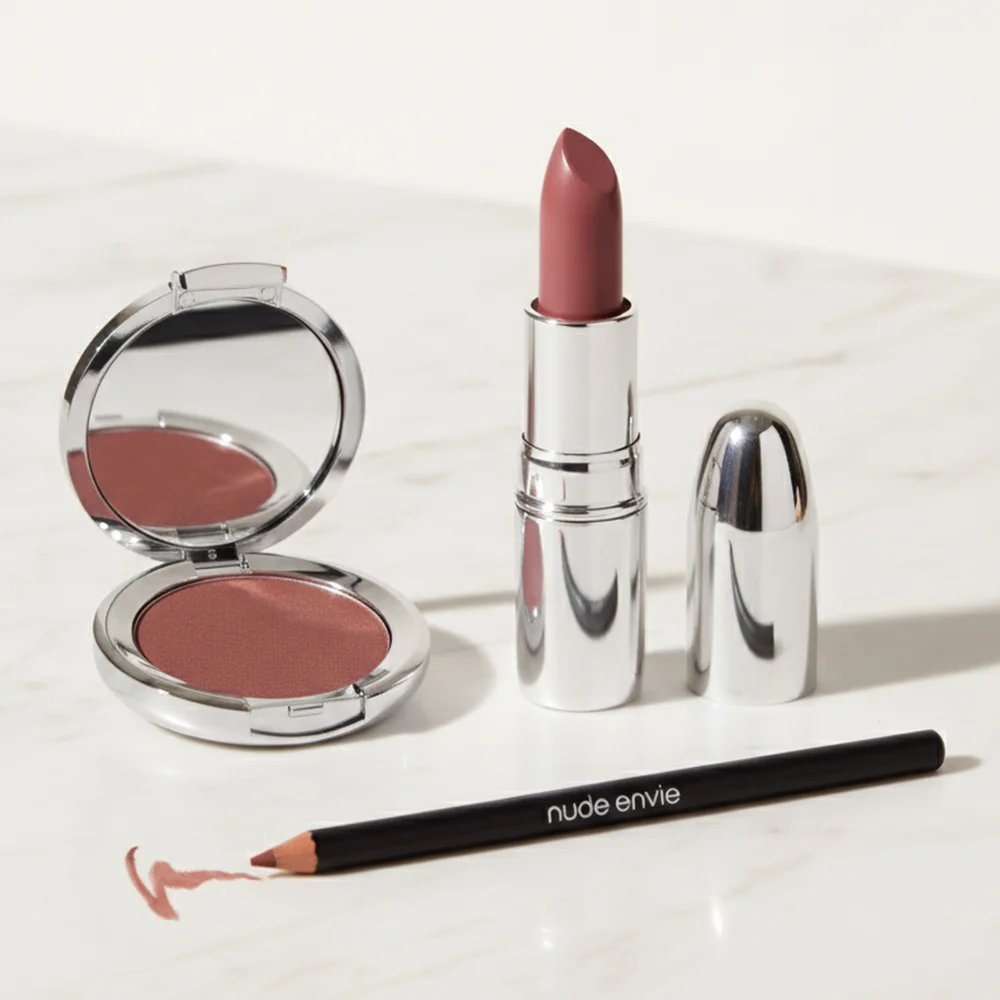
Nude Envie covers both sides of the decision with cruelty-free, vegan cosmetics designed around polished nude color. That means you can focus on the details that make a product worth wearing , from the undertone of a lip shade to the way a soft neutral eye color settles into your look , without having to choose between ethical priorities. For shoppers who want beauty that enhances rather than conceals, both standards belong in the same conversation.
How to Start Building a Cruelty-Free Makeup Routine
Switching to a cruelty-free routine does not require throwing out every lipstick and starting over. A more thoughtful approach is kinder to your budget, your skin, and the products you already love. I prefer making the change one category at a time, beginning with the formulas I use most often. That way, the process feels considered rather than restrictive, and you have time to learn which certification standards matter to you.
-
Audit what you already own
Set aside an afternoon to sort your collection by category: complexion, lips, eyes, cheeks, and nails. Note the brands, shades, and products you genuinely reach for, then check each brand's current cruelty-free policy rather than relying on an old assumption or a retailer description. You do not need to discard a product immediately if the status is unclear. Mark it as undecided while you verify the information, and finish or replace it thoughtfully.
-
Check certification databases, not just front-of-pack language
The words "cruelty-free" can be useful, but they are not a complete verification system on their own. Search the certifier's official database. Check the brand's policy, its ingredient suppliers, and whether the parent company is addressed. This extra step is especially useful when a brand's website makes a broad ethical claim without explaining how it handles third-party testing or international sales.
-
Begin with one category
Choose the part of your routine that gives you the most pleasure. For many people, that is lipstick because a single shade can change the entire look. For others, it is mascara, blush, or a soft neutral eye palette. Replace one finished item at a time, and pay attention to the details that matter in real use: slip. Pigment, comfort, creasing, and how the color looks in daylight. If you are also refining your ingredient preferences, our clean makeup guide is a useful companion.
-
Favor brands with more than one clear commitment
Once you know your priority category, look for brands that pair cruelty-free standards with other certifications or transparent ingredient policies that align with your values. A multi-certified brand can make future shopping simpler, especially when you want cruelty-free and vegan choices together. Nude Envie's curated best sellers are a natural starting point for building a polished routine across lips, eyes, cheeks. And nails, with nude shades organized around the way you actually like to wear makeup.
The goal is not a perfect overnight reset. It is a collection that reflects your standards and still feels beautiful, wearable, and distinctly yours.
Ready to build your cruelty-free collection? Explore Nude Envie's full range of certified cruelty-free and vegan makeup, curated in coordinated nude shades. Book a free virtual consultation to find your perfect match.
Frequently Asked Questions
What does cruelty-free mean in makeup?
Cruelty-free means the brand and its suppliers do not test the finished product or its ingredients on animals. It does not automatically describe the formula itself, and it does not necessarily mean the product is vegan.
How can I tell whether makeup is genuinely cruelty-free?
Look beyond a brand's own wording. Check for a recognized certification, then confirm the brand in the certifier's current database. It is also worth checking the parent company and the markets where the product is sold. Since the phrase "cruelty-free" is a marketing term rather than a universally regulated label. For a quicker first pass, established cruelty-free lists can help you avoid brands that fund animal testing.
Are cruelty-free makeup products always vegan?
No. Cruelty-free addresses animal testing, while vegan refers to the ingredients. A cruelty-free lipstick may still contain beeswax, lanolin, or carmine. If avoiding animal-derived ingredients matters to you, look for both cruelty-free and vegan claims, and check the ingredient list when the certification is unclear.
Does a cruelty-free brand remain cruelty-free if its parent company tests on animals?
Not necessarily. This is where personal priorities matter. Some shoppers assess only the individual brand's testing policy, while others avoid any brand owned by a parent company that supports animal testing. Check the certifier's definition and the brand's current corporate relationship before you buy.
Why can a brand's cruelty-free status vary by country?
Local rules and market access can change the picture. PETA notes that China, Russia, and the European Union still have circumstances involving animal testing requirements or regulatory testing. If a brand sells internationally, check its policy for the specific market rather than relying on a broad statement alone.
Ready to Explore Cruelty-Free Makeup?
Choosing cruelty-free, vegan makeup can feel simpler when the collection has already been thoughtfully narrowed down. If you are ready to find shades that suit your routine while keeping your beauty choices aligned with your values, explore Nude Envie's best-selling collection. Start with the products that catch your eye, then build a routine that feels distinctly yours.