Lip Liner for Olive Skin: Nude Shades That Stay Balanced
The nude liner that looks beautifully seamless on one olive complexion can turn orange, gray, or strangely muddy on another. I judge the shade on the lips, not by the pencil name. A taupe-brown may create a soft shadow, while a peachy nude can bring warmth that needs balancing. Olive undertones are not one fixed color, either. They can lean golden, green, or surprisingly neutral, so the best match is the one that makes your natural lip tone look more even rather than covered.
Shop Nude Envie lip liners for your olive undertone →
The best lip liner for olive skin usually sits close to your natural lip depth, with enough muted brown, mauve, or warmth to harmonize with your undertone without pulling orange or ashy.
Once you know what your undertone is doing in daylight, choosing a liner becomes less about chasing a perfect nude. It becomes more about reading texture, pigment, and finish with a critical eye.
What makes lip liner for olive skin look balanced?
I notice the mismatch first at the corners of the mouth. A liner can be perfectly wearable on paper, yet look orange in daylight, gray in a bathroom mirror, or oddly pale against the rest of the face. Olive skin is not one fixed shade. It can carry green, golden, yellow, or more neutral cues, sometimes at once, which is why a rigid warm-versus-cool rule rarely gives the whole answer.
The encouraging part is that olive complexions can support an unusually broad range of color. Light, dark, and bright makeup can all work; the question is whether the undertone and depth create harmony. A beauty-school guide makes the same broader point while warning that a mismatched complexion color can read unnatural or muddy. That is useful context for choosing lip liner for olive skin: the goal is not to find a shade labeled olive, but to notice what the color does once it meets your skin.
Read the undertone, then watch the temperature
Start by looking at your bare skin in indirect daylight. If you see a soft green cast beside a gold or yellow warmth, you may be olive. If the surface looks more golden than green, a warm-leaning liner may blend more easily. If neither dominates, begin with neutral shades. These are starting points, not verdicts. Your natural lip color, pigmentation, and the depth of the liner will change the result.
For many olive complexions, a muted taupe-brown, balanced brown, or soft mauve-brown creates definition without arguing with the skin. A shade that is strongly orange or peach can turn visibly warm, especially when the rest of the makeup is restrained. At the other extreme, a very pale beige may erase the lip's natural dimension, while an ashy gray-brown can make the mouth look flat. That does not mean those color families are forbidden. It means their intensity and balance deserve a real-life test rather than a shade-name assumption.
Pay attention to the finish as well as the swatch. A matte pencil with concentrated pigment can look more dramatic than the same color in a sheer formula. If you want a polished outline that still feels natural, apply a small amount first and soften the inner edge. The liner should clarify the lip shape and sit comfortably with the rest of your complexion, not create a separate ring of color.
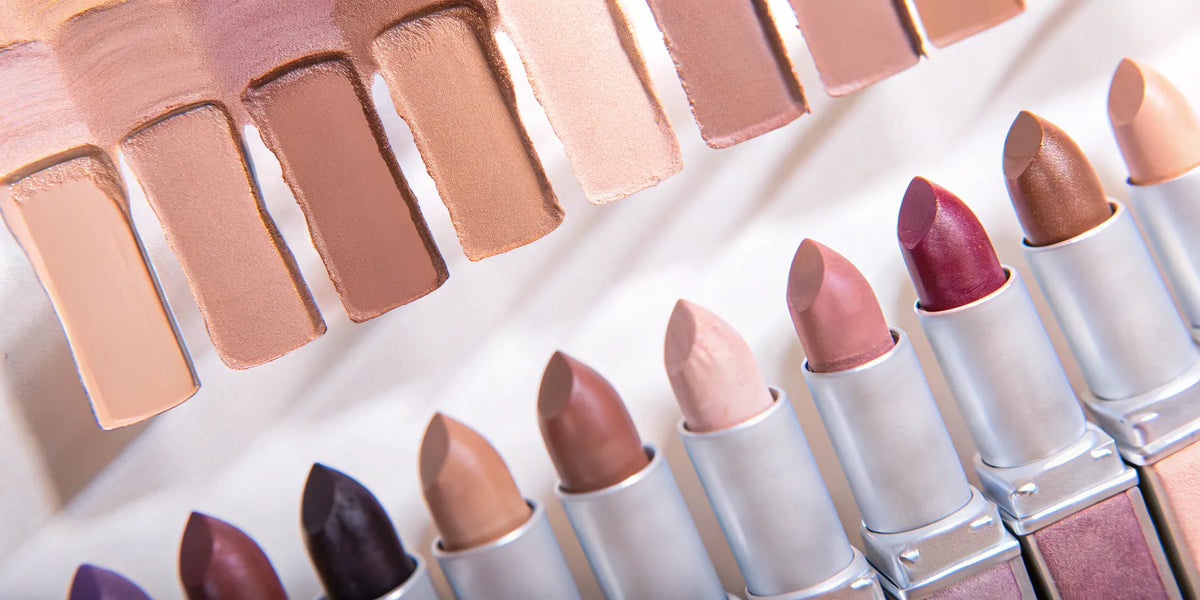
Nude Envie organizes its color navigation around warm, cool, and neutral preferences, which can make the first pass less overwhelming. Use that framework alongside your own reflection, lighting, and lip color. Undertone theory narrows the field; your face makes the final decision.
Which nude shades work best with an olive undertone?
Olive skin rarely behaves like a single undertone chart. It can carry yellow, green, golden, or muted neutral notes. The best nude is often the one that keeps those tones visible rather than trying to cover them. I usually start with the shade that looks quietly believable at the center of the lips, then adjust the depth or temperature from there. A liner that seems beige in the pencil can turn orange, gray, or oddly pale once it meets your natural lip color.
Use the guide below as a direction, not a rigid prescription. Your lip pigmentation, complexion depth, and the finish of the lipstick over it will change the result.
| Direction | What it looks like | Best use | Watch-out |
|---|---|---|---|
| Cool or muted olive | Taupe-brown, muted mauve, or a soft beige with a slightly smoky cast. | Subtle definition, softly overlining the cupid's bow, or grounding a pink-beige nude. | Very gray shades can drain the lips and look flat, especially beside a cool, opaque lipstick. |
| Warm olive | Soft brown, peachy nude, or beige-brown with a gentle golden or pink warmth. | Everyday definition and creating a sun-warmed nude lip without a heavy outline. | Strong orange can fight the green in olive skin and read coppery rather than natural. |
| Deeper olive | Richer soft brown, cocoa, muted berry-brown, or a deeper mauve with enough pigment to remain visible. | Framing the lips under sheer gloss, balancing a medium-to-deep nude, or wearing alone for a defined matte look. | Pale beige can leave a chalky ring. A very cool gray-brown may look ashy instead of sculpted. |
For cool or muted olive
Taupe-brown is my first test when a traditional nude looks too yellow. It gives the lips shape without adding obvious red or orange, while muted mauve brings a little life to a complexion that can make beige disappear. Keep the pressure light and let the natural lip show through. A sheer or satin lipstick on top will soften the pencil further; a full-coverage matte formula will make every temperature shift more apparent.
For warm and deeper olive
Warm olive complexions often suit soft brown and peachy nude directions, but peach should be balanced rather than vivid. If the pencil looks orange before application, expect that warmth to become louder against the skin. Deeper olive complexions generally need enough depth to avoid a pale halo. Rich brown or muted mauve-brown can define beautifully, while a gray or pale beige may look disconnected unless it is blended into a deeper lipstick.
The most useful test is not the pencil alone. Trace a short line at the lip edge, blur one side with your fingertip, and look at it beside your bare lips in daylight. The right lip liner for olive skin should make the mouth look clearer, not like a separate color placed on top.
How do you test a liner before it turns orange or gray?
I never trust a lip liner after one quick swipe on the back of my hand. That skin gives me a color clue, but it does not show how the shade behaves beside the natural pink, brown, or mauve tones around the mouth. Olive undertones are especially revealing. A beige brown can suddenly look peachy, while a taupe that seemed sophisticated in the tube can read flat or gray once it meets the lips.
Give the pencil a small, deliberate audition before you buy it or commit to a full lip. This is the test I use when I am deciding whether a nude is genuinely balanced or merely flattering under store lighting.
- Swatch it close to the mouth. Apply a short line beside the corner of your mouth, or trace a small section of the natural lip border. Keep the pressure light enough to see the actual undertone rather than a thick, over-pigmented stripe. A smooth, semi-matte brown may look neutral alone, yet show a warmer or pinker cast against the skin. That shift is useful information, not a failure of your complexion.
- Check it in daylight first. Stand near a window and look at the liner without a lipstick over it. Daylight exposes orange, peach, and yellow pulls more honestly than warm bulbs. If the shade makes the surrounding skin look sallow or the mouth look disconnected, it is probably too warm or too light for the effect you want. If it looks dusty, bruised, or noticeably ashy, the gray balance is working against you.
- Look again under indoor light. Move to the lighting where you actually wear makeup. A liner that appears elegant and muted outside may become pink indoors, while a soft brown can deepen and look heavier. I look for a shade that remains intentional in both settings, even if its character changes slightly. Olive skin can handle plenty of color. Do not reject a liner simply because it is visible. Reject it when the color overwhelms the lips or turns muddy.
- Wait for the shade to settle. Leave the swatch alone for several minutes. Watch whether the finish becomes drier, darker, or more pronounced as it settles. Then press a clean fingertip over one edge. If the pigment vanishes immediately, it may be too sheer for the definition you want. If it leaves a hard, powdery rim, test it with a lighter application and a balm or lipstick before deciding.
- Make the final call beside your intended lip color. Add the lipstick or gloss you plan to wear. The right liner should give the mouth shape without creating an orange halo, a gray outline, or a disappearing border. For a first comparison, a Spicy lip liner shade can be evaluated this way as a product-navigation example, not as an undertone promise.
A wear test cannot promise how every formula will perform for every person. It can, however, reveal the most important thing before purchase: whether the color stays believable beside your own lips.
How to apply a nude liner without a hard outline
The difference between polished definition and a visible ring is usually pressure, not precision. I use less product than I think I need, then build the shape in thin passes. That keeps the liner looking like part of the lip rather than a border drawn around it.
Start with a comfortable surface
Begin with clean, softly conditioned lips. If there is balm sitting on top, press a tissue over the lips before lining; excess slip can make the pencil skip or blur before you have finished. Very dry texture deserves a little more attention. Smooth away loose flakes gently, add a small amount of balm, and give it a moment to settle. The goal is supple skin, not a glossy coating.
Build the edge, then soften it
Rest your elbow on a surface if that helps steady your hand. With a nude liner, trace the natural lip edge using short strokes and a light touch. I prefer starting at the cupid's bow and corners, then connecting those points instead of drawing one uninterrupted circle. If you want a little more definition, extend only where the natural contour disappears. Keep the adjustment subtle and symmetrical.
Next, use the side of the pencil or a small lip brush to diffuse the inner edge by a few millimeters. Do not erase the outline entirely. You are softening the transition so the color fades toward the center, not creating a second, hazy shape outside the lip. This is especially helpful when a nude shade is noticeably deeper than your natural lip tone.
Fill the corners before the center
Color the outer corners and the first third of each lip, where lipstick often thins first. Then blend inward with short strokes. Leaving the center bare can make the outline look stark, while filling the entire lip gives your lipstick a more even base. Nude Envie describes its liners as full-coverage, matte, and smooth-gliding, with precise definition intended to help prevent feathering and enhance lipstick wear. I would still apply a thin layer rather than pressing hard for maximum pigment.
Blot once, then check the finish
Press the lips together gently or blot once with tissue. Inspect the result in natural light, particularly around the corners and lower lip. If you can see a distinct ring, soften the inner edge with a clean brush or fingertip and add a touch of lipstick through the border. A satin or sheer lip color can help marry the textures without hiding the shape. For broader technique guidance, the Nude Envie lip liner guide is a useful adjacent resource.
Nude Envie lip liners to explore by color direction
When I am choosing a nude liner, I want the name to invite curiosity, not make a promise the swatches cannot support. That is especially true when shopping for a lip liner for olive skin. Olive complexions can read green, golden, or neutral depending on the person and the light. So a shade name alone is not enough to tell you exactly how it will look. Nude Envie makes that exploration more manageable by organizing color navigation around warm, cool, and neutral preferences.
The current lip liner range includes six names: Classy, Elegant, Perfect, Rich, Spicy, and Timeless. I would treat them as a curated set to investigate rather than assign one automatically to olive undertones. Without verified swatches on your own lips or a comparable complexion, it would be guesswork to say that any one of these is universally the right choice. A shade that appears softly balanced on one person may look pinker, browner, or more muted on another.
A formula built for definition
Nude Envie describes its lip liners as full-coverage, matte formulas with a smooth glide. That combination is useful when you want to see the shape of the lip clearly and create a controlled edge before adding color. The positioning is precise rather than sheer and diffused, so use a light hand at first. Especially when you are still deciding whether the undertone harmonizes with your skin.
The formula is also intended to help prevent feathering and enhance lipstick wear. Think of the liner as part of the architecture of the look: define the border, then soften or fill it according to the finish you want. It is described as vegan, cruelty-free, and paraben-free, which may matter if those are part of your makeup standards.
For a first look at the range, browse the Nude Envie lip liner collection. You can also use the Spicy lip liner shade page as a product-navigation example, not as an undertone verdict. If warm, cool, and neutral labels still leave you uncertain, the Virtual Beauty Consultation offers a more personal direction before you commit.
How should olive-skin liner pair with lipstick or gloss?
I tend to choose the lip color first, then decide how much structure the liner needs. Olive skin can make a nude shift subtly greener, warmer, or more muted depending on the light. So the liner should connect the lip to the complexion rather than create a separate brown border. Think of depth and finish as two different controls: depth creates shape, while finish decides how polished or diffused the result feels.
For a sheer gloss, keep the liner soft
A sheer gloss is the easiest pairing when you want the liner to look like part of your lips. Use a liner close to your natural lip depth, sketching just along the edges and softly filling the corners. Avoid an opaque, sharply squared outline under a transparent finish; it can read heavy even when the gloss itself is delicate. Nude Envie describes its glosses as lightweight, sheer, high-shine, and non-sticky, with lasting hydration, so a lightly diffused liner gives that finish enough definition without taking over. Explore the Nude Envie lip gloss collection when you want to build this kind of low-contrast look.
For satin lipstick, match depth before undertone
Satin lipstick gives you more color, but it still benefits from a liner that is close in depth. If the lipstick is a light nude, choose a liner only slightly deeper to keep the mouth dimensional. With a medium or richer lipstick, let the liner follow the same color family and use it to refine the perimeter rather than visibly compete with the center. Nude Envie describes its lipsticks as full-coverage, lightweight, and pearlescent satin, which makes a clean, softly blended edge especially useful. For more specific color guidance, compare this technique with the recommendations in nude lipstick for olive skin.
For a defined matte look, let the liner do more work
Matte lipstick can support a stronger outline, particularly for evening makeup or when you want a precise, sculpted lip. Trace the natural border first, then fill the outer corners so the lipstick has a stable base to meet. Keep the center slightly lighter only if the contrast looks intentional. A liner that is much deeper than the lipstick can pull a nude lip gray or overly brown against olive skin. Nude Envie describes its liners as matte, full-coverage, and smooth-gliding, with precise definition and a role in preventing feathering and enhancing lipstick wear. The broader nude lipstick and liner sets guide is useful when you prefer to coordinate the two products from the start.
The most convincing pairing is rarely the most dramatic one. Adjust pressure, coverage, and depth until the liner supports the lipstick or gloss, then check the result in natural light before deciding whether it needs more definition.
Get personal help choosing your olive-skin liner →
Frequently Asked Questions
What color lip liner is best for olive skin?
Start with a muted nude that echoes the depth of your lips, then decide whether taupe-brown, soft brown, muted mauve, or a warmer beige feels more harmonious. Olive skin can read green, golden, or neutral, so there is no single universal answer. On my complexion, a slightly softened brown usually looks more natural than a very pink beige. Test the liner in daylight and check whether it makes your lips look defined rather than gray, orange, or disconnected.
What lip colors look best on olive skin?
Olive undertones can carry a surprisingly broad range, from understated nudes to deeper browns, rosy mauves, terracotta, and clear reds. The most flattering choice depends on depth, contrast, and finish as much as undertone. For an everyday look, pair a balanced nude liner with a satin lipstick or sheer gloss. For more definition, choose a liner a touch deeper than your natural lip color and soften the inner edge so the result stays polished.
What colors should you avoid with olive skin tone?
I would not ban a color outright, but be cautious with shades that make your complexion look muddy or your lips look gray. Very pale beige can flatten the mouth, while an overly orange or intensely pink liner may compete with olive tones. A shade that looks wrong in one lighting setup may work beautifully in another. So swatch it near your lips and view it in both natural and indoor light before committing.
What colors make olive skin tan pop?
To make a tan look luminous, try contrast without abandoning balance: a warm nude, soft brown, muted rose, or terracotta-leaning lip can bring out golden warmth. Keep the liner close to the lipstick's depth, especially if the formula is matte and full coverage. If the look feels heavy, blur the outline slightly and add a lighter satin or sheer finish at the center of the lips.
Ready to find your olive-skin liner direction?
The right nude can make the whole look feel more considered, especially when you are choosing between a warm, cool, or neutral finish. Browse the Nude Envie range, then book a Virtual Beauty Consultation if you want help narrowing the options. A second opinion can make it easier to choose a liner that supports your lipstick instead of competing with it.